
"Hunger Games": A Captivating Dystopia on the Future of Our Societies
Written by Suzanne Collins, Hunger Games is much more than just a young adult book series. By depicting a dark future where survival is a cruel game, this bestseller offers us a striking reflection on power, resistance, and the excesses of a hyper-controlled society.
By Titouan Winkel
published on October 23, 2024 at 6:00 PM

Panem: A Fascinating Dystopian World
The universe of Hunger Games takes place in a post-apocalyptic future where the nation of
Panem, divided into 12 districts,
is subjected to the tyranny of the Capitol.
Each year, the latter organizes the "Hunger Games", a televised game
"In Hunger Games, the survival of the fittest is just a facade masking the control mechanisms of an unequal society."
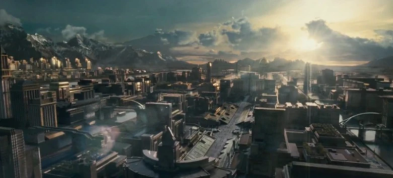
Image taken from the film adaptation of the novel
Author Suzanne Collins draws inspiration from many current themes, such as media manipulation, class struggle, and political oppression, to paint a picture of a future where absolute power reduces human freedom to nothing.
Katniss Everdeen: Symbol of Resistance
The heroine of the saga, Katniss Everdeen, embodies the face of rebellion.
By defying the cruel rules of the Hunger Games, she quickly becomes the symbol of opposition to the Capitol.
Through her journey, the reader explores the universal themes of courage, sacrifice, and solidarity in a
dehumanized world.
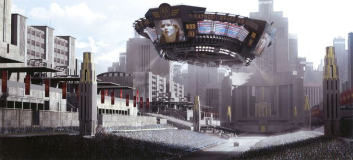
Image taken from the film adaptation of the novel
A Warning About Our Future?
While Hunger Games is a work of fiction, it raises questions that strongly resonate with
current concerns: how far could technology and inequalities lead us? How can we avoid a society where
entertainment becomes a tool of control?
The world imagined by Suzanne Collins can be seen as a warning about the dangers of totalitarian regimes and
societies based on division.